Resort owners usually ask the question in the wrong order. They ask what the water park costs before asking what it would change. A resort water park is not a standalone attraction; it is an amenity that has to lift room rates, fill shoulder nights and keep families on property. If it does those three things, the investment is easier to justify than any ticket revenue forecast.
This article sets out the case for and against, with the cost and revenue lines that actually decide it.
The Business Case
A resort water park creates value in three places:
- Room rate. A family-oriented water amenity supports a higher rate in the family segment.
- Occupancy. It fills shoulder and off-peak nights when the hotel would otherwise discount.
- On-property spend. Families that stay on site for the water park buy food, drinks and poolside services.
Model those three effects, not the park ticket line. A park that lifts average occupancy by a few percentage points across a large room count usually contributes more than its own ticket revenue – provided the operating cost is controlled.
Costs to Include
The how much does a water park cost to build is the starting point, but a resort project adds integration costs: upgraded power, drainage, changing facilities, access routes and landscaping. Those often equal 20 to 30 percent of the attraction package.
The land and site preparation costs for a water park deserve their own line in the model. Earthworks, retaining walls and drainage can vary by a factor of three between a flat, serviced plot and a sloped site with poor ground, and that variance sits outside the attraction quotation.
Operating costs are the line owners underestimate. Lifeguards, filtration energy, chemicals and maintenance continue whether the park is full or empty. A realistic model includes the first three seasons, not just the opening year.
What Makes a Resort Project Succeed
Right size for the guest mix
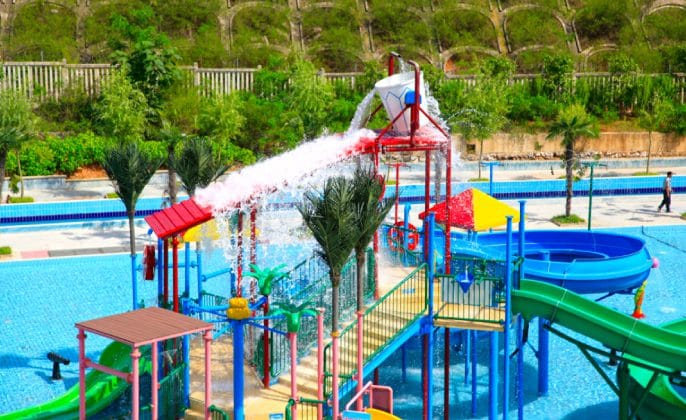
A small vs large water park cost is not simply a question of land. A city resort may need a compact splash area; a beach resort can justify slides and a leisure pool. Size the park to peak occupancy, then check the design against the budget.
Materials matter at resort scale too. Splash structures and play panels are commonly produced in Polyethylene and fibreglass, and the finish is judged by guests every day – UV-stable gelcoat and stainless fixings are worth the small premium.
Integration with the property
The park should feel like part of the resort, not a separate business. That means a short walk from the pool deck, consistent landscaping and a changing facility that guests can reach without crossing a service area.
Honest operating plan
Decide early whether the park is guest-only or open to day visitors. Day passes add revenue but require separate access control, more changing capacity and a ticket system. Retrofitting a public entrance into a resort park is expensive.
When It Is Not Worth It
- The resort has no meaningful family segment
- There is no space for shade, changing rooms or a service route
- The property cannot fund three months of operating costs before stabilising
- Local regulations make outdoor water attractions impractical for most of the year
A Simple Payback Model
| Input | Example |
|---|---|
| Total project cost | USD 800,000 |
| Rooms | 200 |
| Occupancy lift | 4 percentage points |
| Average room rate | USD 180 |
| Annual incremental room revenue | USD 525,000 |
| Park operating cost | USD 250,000 |
| Net contribution before tax | USD 275,000 |
On those assumptions the project pays back in about three years. The result is sensitive to the occupancy lift and the operating cost, so test both at pessimistic values before committing.
Common Mistakes
- Designing for the available land instead of the guest count
- Under-sizing the plant room to save space
- Leaving shade and changing facilities out of the initial budget
- Choosing thrill slides for a family-dominated audience
- Ignoring the operating cost in the investment case
How to Phase the Project
Most resort water parks open in two stages. Stage one delivers the splash zone, leisure pool and changing facilities – about 60 percent of the eventual attraction spend – and starts generating the amenity value that justifies the project. Stage two adds slides and additional shade once the guest response is known.
The plant room should still be sized for the final configuration. Expanding filtration and pipework later costs far more than the interest saved by delaying the equipment purchase.
One more consideration: resorts with a strong spa or adults-only segment should position the water park clearly, so it does not undermine the quiet atmosphere the property sells. A separate entrance, planting and operating hours usually solve the problem without reducing the park.
Frequently Asked Questions
Is a water park a good investment for a small resort?
It can be, if the property already attracts families. For a small property, a splash area is usually a better fit than a full water park.
How much does the integration cost?
Typically 20 to 30 percent of the attraction package, depending on how much power, drainage and building work the property needs.
Should the park be open to the public?
Only with separate access control and sufficient changing capacity. Decide before the layout is finalised.
Next Step
Send us the room count, guest profile and site area, and we will model the case with a configuration that fits. Our water park design by Dinis team handles the layout, attractions and plant, and as an amusement equipment manufacturer we can advise on the local site works. For the full cost structure, discover more.
